
HomeServicesEV Charger Installation
EV Charger Installation in Hendricks County
Level 2 home charging for every make of electric vehicle, wired on its own 240-volt circuit, mounted where the cord reaches the car, and permitted so your insurance and your warranty stay clean.
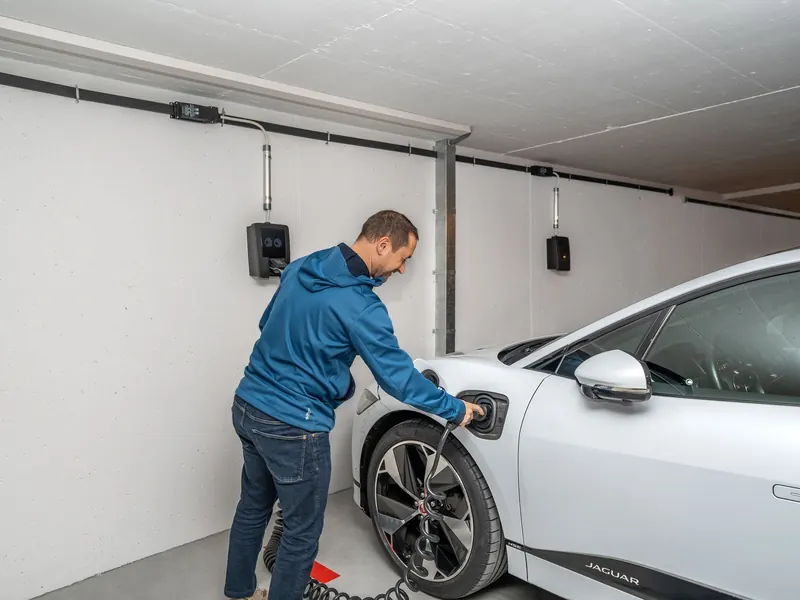
The charger is the easy part. The circuit behind it is the job.
A wall charger takes twenty minutes to hang. What makes an EV charger installation right is everything before that: confirming the panel can carry another 40 to 60 amps, running the correct gauge wire for the distance, protecting the circuit the way the code requires, and mounting the unit so the cable reaches the charge port on your car, in your garage, without becoming a trip hazard.
Hendricks County has turned into EV country faster than its houses were wired for. The 1990s and 2000s subdivisions in Avon, Plainfield and Brownsburg have attached garages and 150 or 200 amp panels, which is a good starting point. Older homes in Danville and Mooresville often have 100 amp services, and that changes the plan.
What we sort out before quoting
- Which charger: the one that came with the car, a Tesla Wall Connector, or a smart unit like ChargePoint, Emporia or Wallbox
- Hardwired or a NEMA 14-50 outlet, and why we usually recommend hardwiring
- How many amps the charger will draw and whether the panel has the capacity and a free slot
- The distance from the panel to the parking spot and the route the wire will take
- Garage, carport or outdoor mount, and where the car actually parks
- Whether load management can avoid a service upgrade
How an EV charger install goes
- Panel and load check. We look at the main breaker, count the open slots, and run the load calculation with the charger included. This is where we tell you if a panel upgrade or a load-management device is needed, before you buy anything.
- Pick the amperage. Most drivers are well served by a 40 or 48 amp charger on a 50 or 60 amp circuit. A charger set higher than the house can support just trips breakers; we size it to the car, the driving and the panel.
- Run the dedicated circuit. Correct gauge copper for the distance, in conduit where it is exposed, with GFCI protection where the code calls for it and a disconnect where needed.
- Mount and connect. Charger set at a working height with the cable reaching the charge port on the side of the car it is actually on. We commission smart chargers on your wi-fi before we leave.
- Permit and inspection. EV circuits are permitted work in the towns we serve. We pull it and meet the inspector.
Hardwired charger or a 14-50 outlet?
A NEMA 14-50 outlet is flexible and lets you unplug a portable charger for a road trip. A hardwired charger can be set to draw more current, has no plug connection to loosen or overheat, and avoids the expensive GFCI breaker the code now requires on a garage outlet. For a charger that is going to live in one spot, we usually recommend hardwiring. If you want the outlet, we install a quality industrial-grade receptacle, not the bargain one that has caused so many melted plugs.
When the panel is full: load management instead of a service upgrade
Plenty of 200 amp panels in Avon and Brownsburg are physically full of breakers even though the house has capacity to spare. Depending on the situation we can add a subpanel, use a tandem breaker where the panel allows it, or install a charger with built-in load management that throttles itself when the rest of the house is busy. Each option is cheaper than a service change, and we tell you which one fits.
Tesla, Ford, Rivian, GM, Hyundai and Kia
We install the manufacturer's own charger or any third-party unit. The Tesla Wall Connector, Ford Charge Station Pro, and the NACS and J1772 smart chargers all wire the same way at the panel; the differences are in the amperage settings and the app setup, and we handle both. Bring us the model number and we will tell you the circuit it needs.
EV charger installs by town
Zionsville and the newer Avon subdivisions along the Rockville Road corridor have the garages and the panels that make for straightforward installs. Brownsburg's newer builds along the 56th Street corridor usually have panel room; the older homes on the Plainfield and Danville side more often need the panel looked at first.
EV charger questions
Mostly the distance from the panel to the charger and the route the wire has to take, plus the amperage of the circuit, whether the panel needs work, and the permit fee in your town. A charger on the wall next to the panel in an attached garage is the simplest case. A detached garage or a run through a finished basement takes more. We quote after seeing both ends of the run.
Federal credits for home charging equipment have come and gone and have depended on where you live. Some Indiana utilities have offered rebates or off-peak charging rates. Because the programs change, we suggest checking your utility's website and asking your tax preparer for the year of the install; we give you an itemized invoice either way.
Charging at home costs what the electricity costs, which for most drivers is far less than gas for the same miles. The charger itself draws almost nothing when the car is not plugged in. If your utility offers a time-of-use rate, a smart charger can be set to charge overnight when power is cheapest.
Please do not. Dryer circuits are 30 amps and the outlet is usually not rated for the continuous load an EV draws for hours at a time; melted outlets are the common result. A dedicated circuit with the right receptacle or a hardwired charger is the safe version of the same idea.
Related work and nearby towns
Tell us the car and where it parks.
A photo of the panel and one of the garage wall is usually enough for a firm quote. Text them over or use the form.
(317) 681-2616